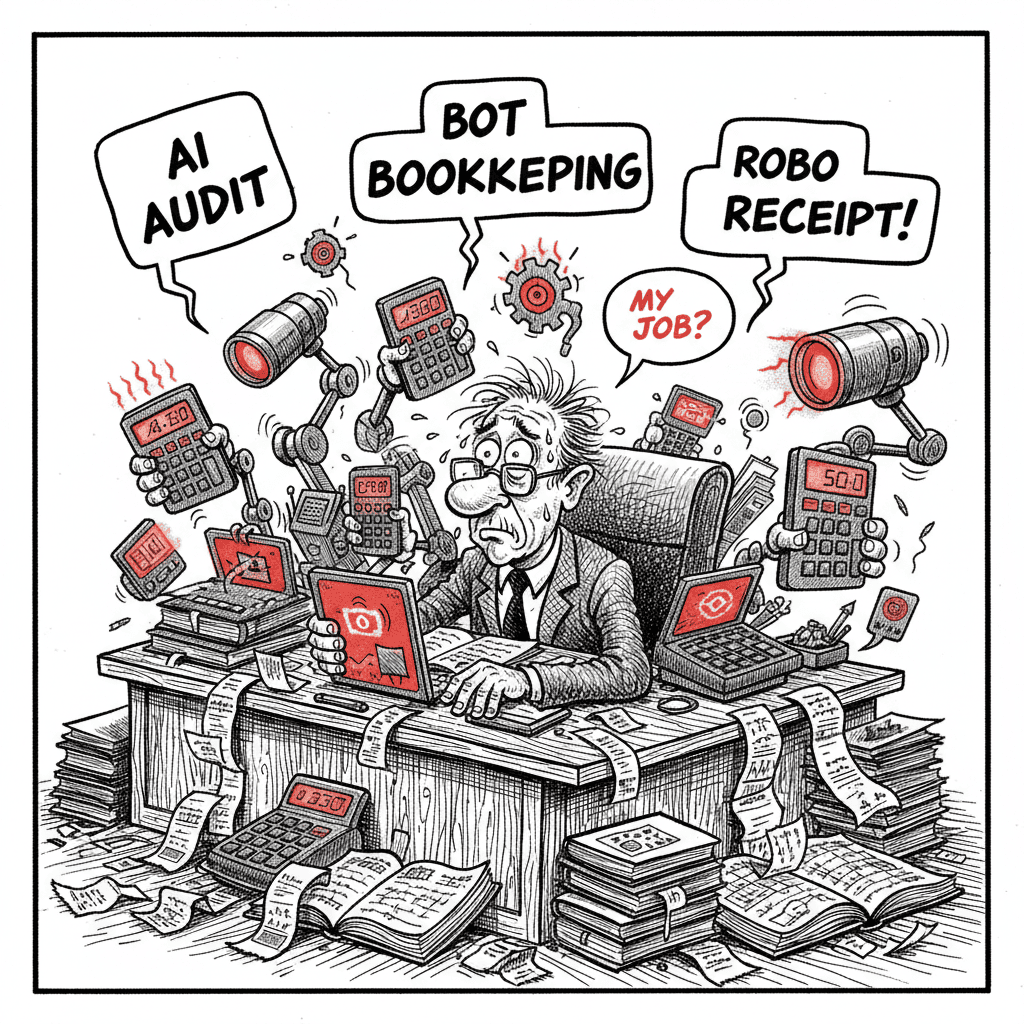
Stop asking “will AI replace bookkeepers?” Wrong question.
Ask instead: “How much bookkeeping work will humans still do?”
Automation Risk Score
Task analysis of routine bookkeeping work
At 82%, bookkeeping sits near the top of at-risk professions. But the picture isn’t as simple as one number. Not all bookkeepers face equal risk. Not all paths lead to unemployment.
The Tech That’s Eating Your Job
Four Technologies. One Problem.
Cloud Accounting (QuickBooks, Xero, FreshBooks)
Bank transactions import automatically. Invoices match to payments without human eyes. Reconciliation runs in the background. Financial statements generate on demand.
Days of work? Now minutes. Sometimes zero.
Machine Learning Features
The software learns your patterns. It categorizes transactions the way you would. Receipts get scanned, read, and filed. Errors get flagged before you see them. Cash flow predictions appear without asking.
Direct Bank Feeds
No more manual data entry. Transactions flow straight from your bank to the ledger. The keyboard work that defined bookkeeping? Mostly gone.
Receipt Apps (Expensify, Dext)
OCR reads the receipt. AI categorizes it. Approval workflows run automatically. Posting happens without you.
The Numbers Tell The Story
What’s Gone vs. What’s Left
Already Automated
- Bank reconciliation (software matches everything)
- Invoice processing (AI reads, sorts, posts)
- Expense reporting (receipts scan themselves)
- Standard reports (one click generation)
- Sales tax (calculated at checkout)
Still Human (For Now)
- Weird transactions that don’t fit categories
- Year-end adjustments requiring decisions
- Explaining numbers to confused clients
- Hunting down discrepancies
- Advising on financial decisions
Changing Fast
- Payroll (automated but needs oversight)
- AR/AP management (getting better monthly)
- Basic financial analysis (AI improving rapidly)
Timeline: When Does This Hit?
The change isn’t coming. It’s here. The question: do you lead it or get run over by it?
2020-2024: Done
- Transaction entry automated
- Bank feeds standard
- Receipt scanning everywhere
2024-2026: Now
- AI categorization reliable
- Exception handling improving
- Small business adoption accelerating
2026-2028: Soon
- Small business bookkeeping nearly autonomous
- Humans shift to oversight and exceptions
- Workforce shrinks noticeably
2028-2030: Coming
- Role fundamentally different
- Advisory work dominates
- Entry-level positions scarce
What This Means For You
Staff Bookkeeper?
Your job will likely:
- Shrink to part-time
- Become exception handling
- Merge into other roles or vanish
Running a Bookkeeping Practice?
Your business model needs surgery:
- Charging by transaction? Dead model. Software is free.
- Advisory services? Future. Help clients understand their numbers.
- Specialization? Survival. Industry expertise, complex cases, high-touch clients.
Thinking About Entering Bookkeeping?
Four Paths Forward
Detailed automation analysis with course recommendations
View Bookkeeper Analysis →Path 1: Up To Accounting
Full accountant roles (55% risk) handle messier work:
- Financial statement prep and analysis
- Audit support
- Complex tax situations
- Management reporting
Requirements: Bachelor’s degree or heavy coursework. Maybe CPA.
Timeline: 2-4 years for the degree.
Path 2: Advisory Services
Financial advisor/consultant work focuses on what numbers mean:
- Cash flow planning
- Budget support
- Business decision analysis
- Financial coaching
Requirements: Communication skills. Business sense. Maybe CFP certification.
Timeline: 6-12 months to start.
Path 3: Financial Analysis
Financial Analyst (45% risk) looks forward, not backward:
- Forecasting and modeling
- Performance analysis
- Strategic planning
Requirements: Excel mastery. Financial modeling knowledge. Maybe MBA.
Timeline: 1-2 years of focused study.
Path 4: Finance + Operations Hybrid
Finance Operations combines your knowledge with process work:
- Financial systems admin
- Process improvement
- Compliance coordination
Requirements: Systems knowledge. Basic project management.
Timeline: 3-6 months to transition.
Start Now
Step 1: Audit Your Work
- How much is routine transaction processing?
- How tech-forward is your employer/client?
- How much involves judgment and conversation?
Step 2: Build Advisory Muscle
Even if you stay in bookkeeping, the work shifts toward:
- Explaining results
- Making recommendations
- Solving unusual problems
Practice now.
Step 3: Master The Tools
- Learn QuickBooks/Xero advanced features
- Train others on implementation
- Position as the automation expert
Step 4: Get Certified
Credentials that signal higher-level capability:
- CPA (if going accounting route)
- Enrolled Agent (tax focus)
- QuickBooks ProAdvisor (tech positioning)
- CFP (advisory route)
Bottom Line
Routine bookkeeping is ending. The profession transforms. Winners will:
- Move up to complex accounting
- Move sideways into advisory and analysis
- Become experts in the technology doing the automating
Full analysis: bookkeeper automation risk with courses and transition paths.